
In Manhattan’s hidden corners, where alleyways blur into afterthoughts and forgotten basements hum with possibility, there are nights that feel conjured rather than planned. Last Friday at The Ground, glaive summoned one of those nights; a secret show staged on the artificial green of an indoor soccer court, a place never meant for this type of noise yet transformed into a sanctuary for hyperpop’s restless pulse. A metal fence stood as the lone threshold, separating the exhaustion of the week from the sacred promise inside. Fans press forward, leaving their heaviness with the barbed wire, stepping instead into something unrepeatable – an evening suspended between spectacle and secrecy, where both artist and audience collided in a shared fever dream.
It wasn’t just a show; it was a christening. In honor of his brand-new record Y’all, glaive offered his devotees the rare chance to hear these songs break open for the first time in a live setting. The tracks, barely a day old on streaming services, breathed differently in this space, charged with the urgency of bodies colliding, voices echoing, and hearts catching on every synth line. glaive himself admitted he hadn’t fully mastered the live renditions yet and that the production of the venue was unforgiving, but no one cared – the imperfections only underlined the intimacy of the night. From the opening beat of “Asheville,” he had the ground in his grip, each lyric reverberating back like scripture already memorized. Maybe I’m partial, having grown up with New York stitched into my veins, but there’s nowhere else that could’ve delivered this kind of communion. Even glaive himself confessed it on stage: this city outshines Los Angeles, and for him, it now feels more like a home.
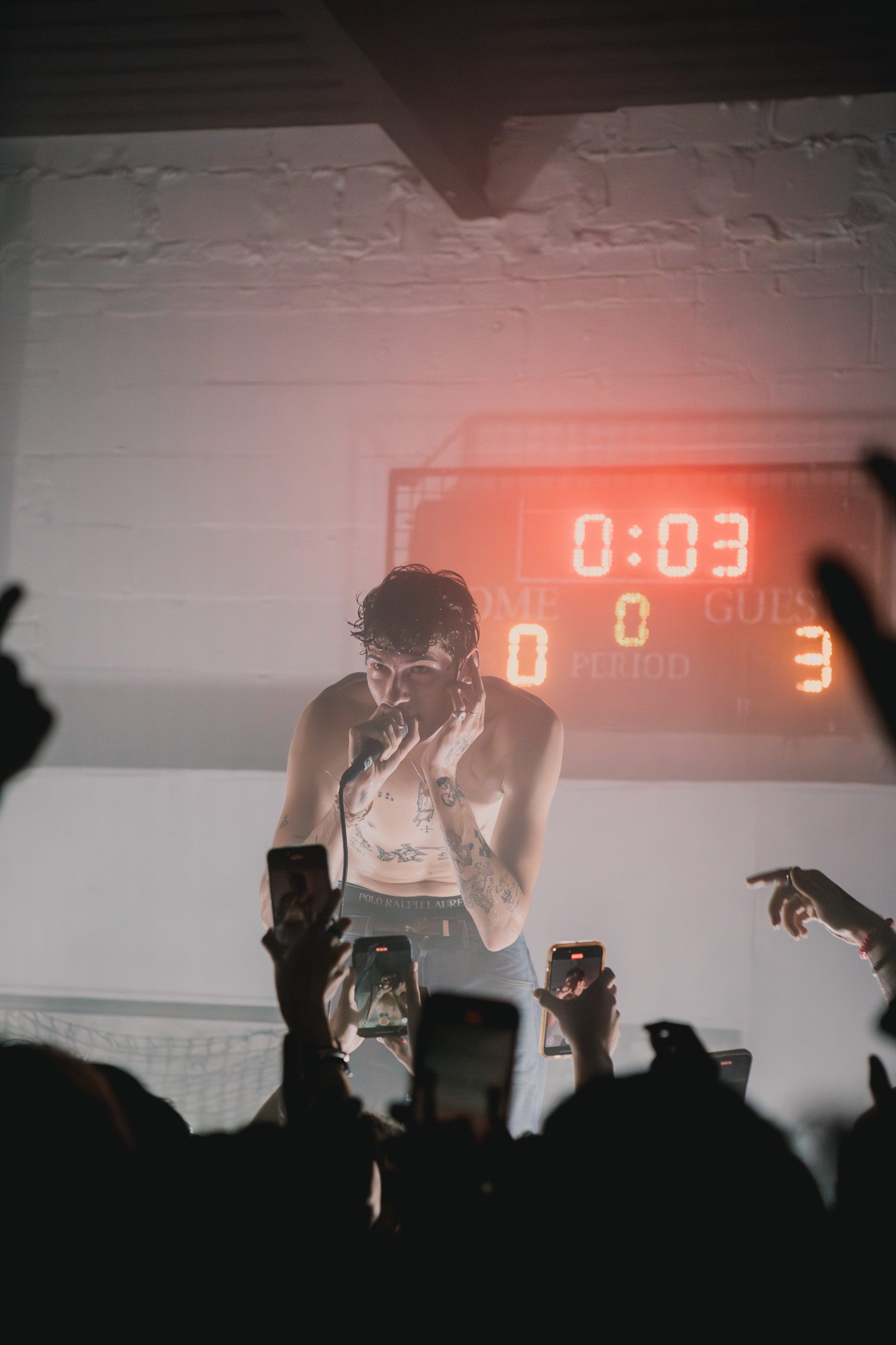
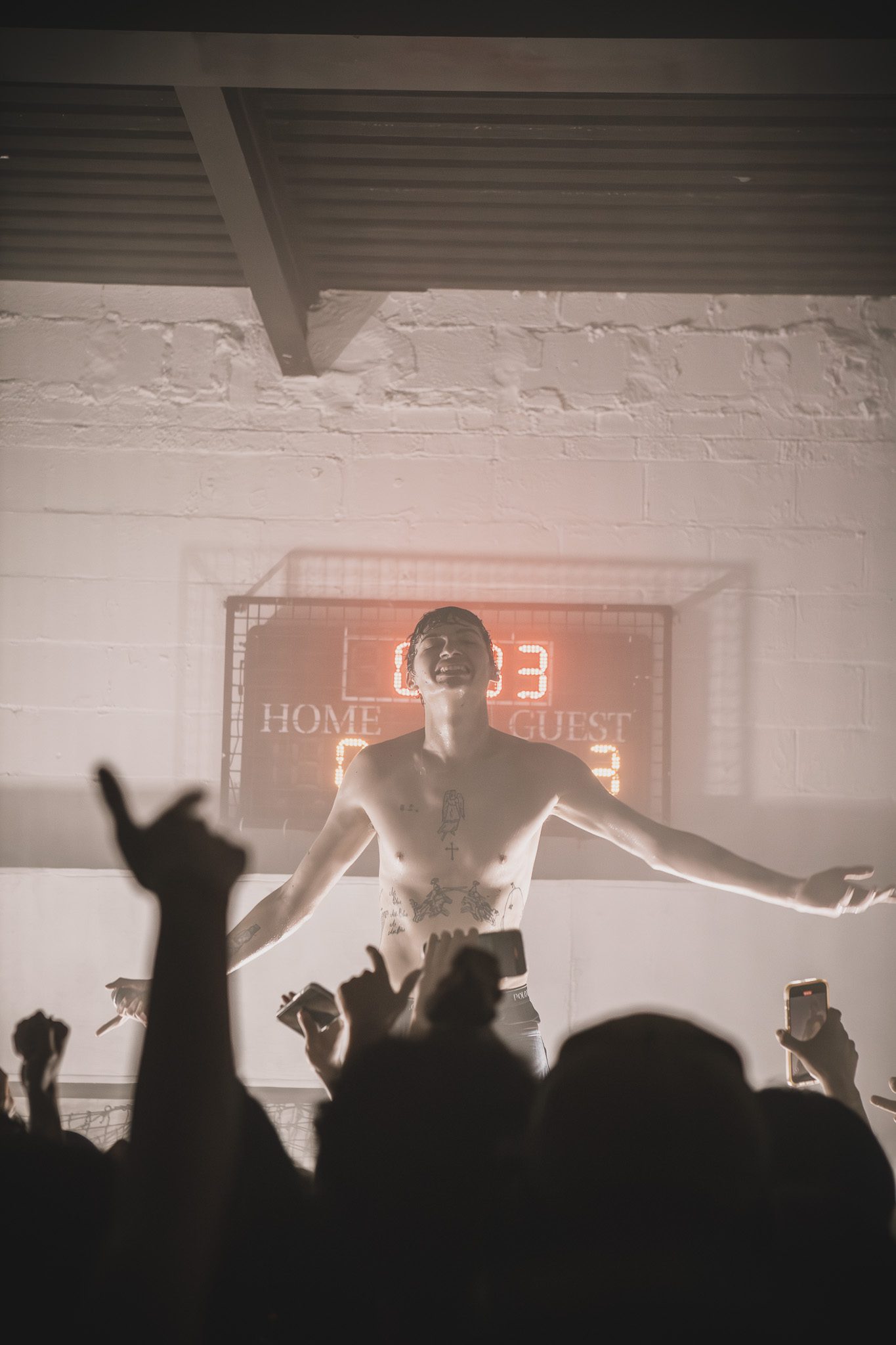

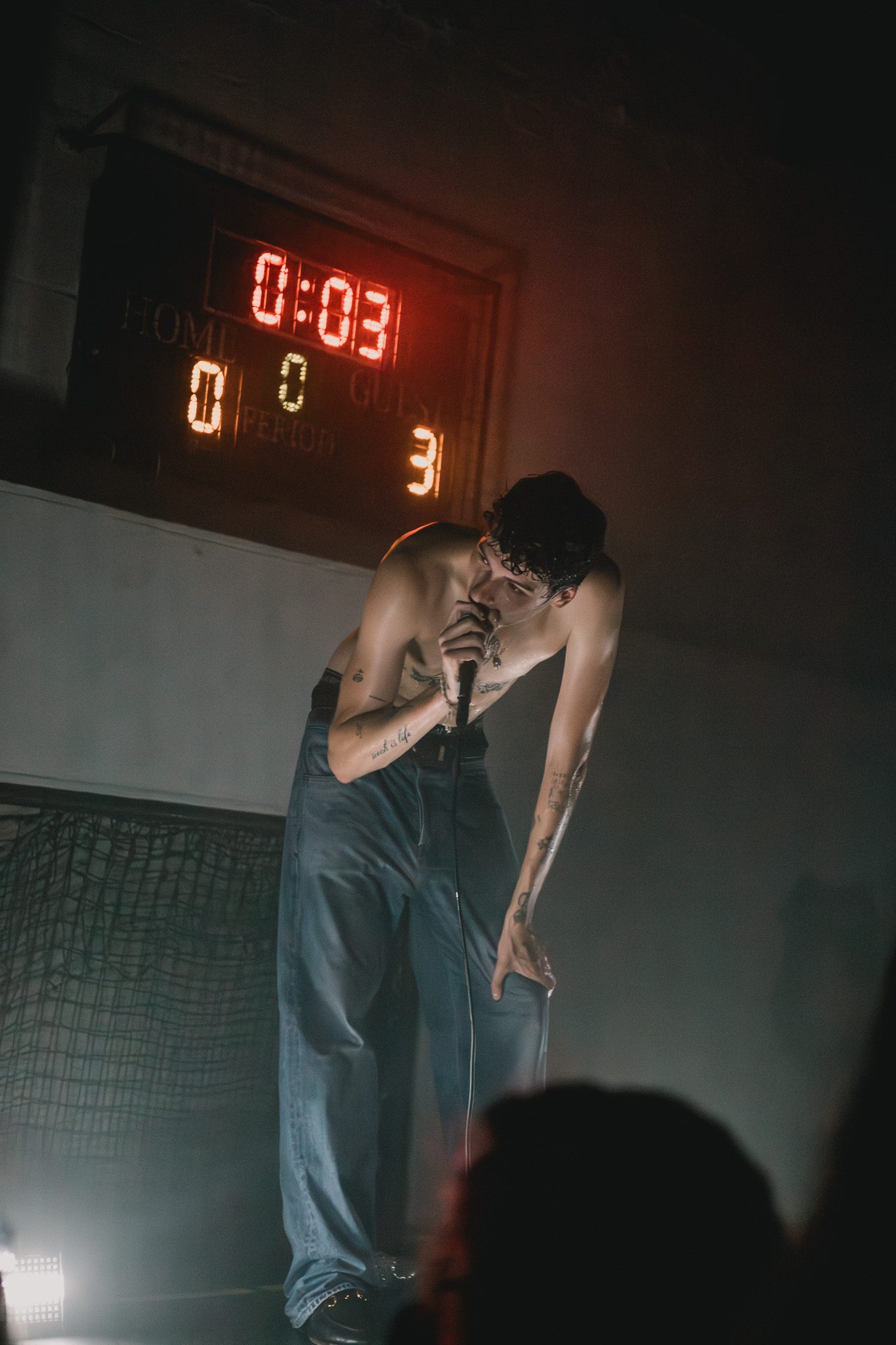
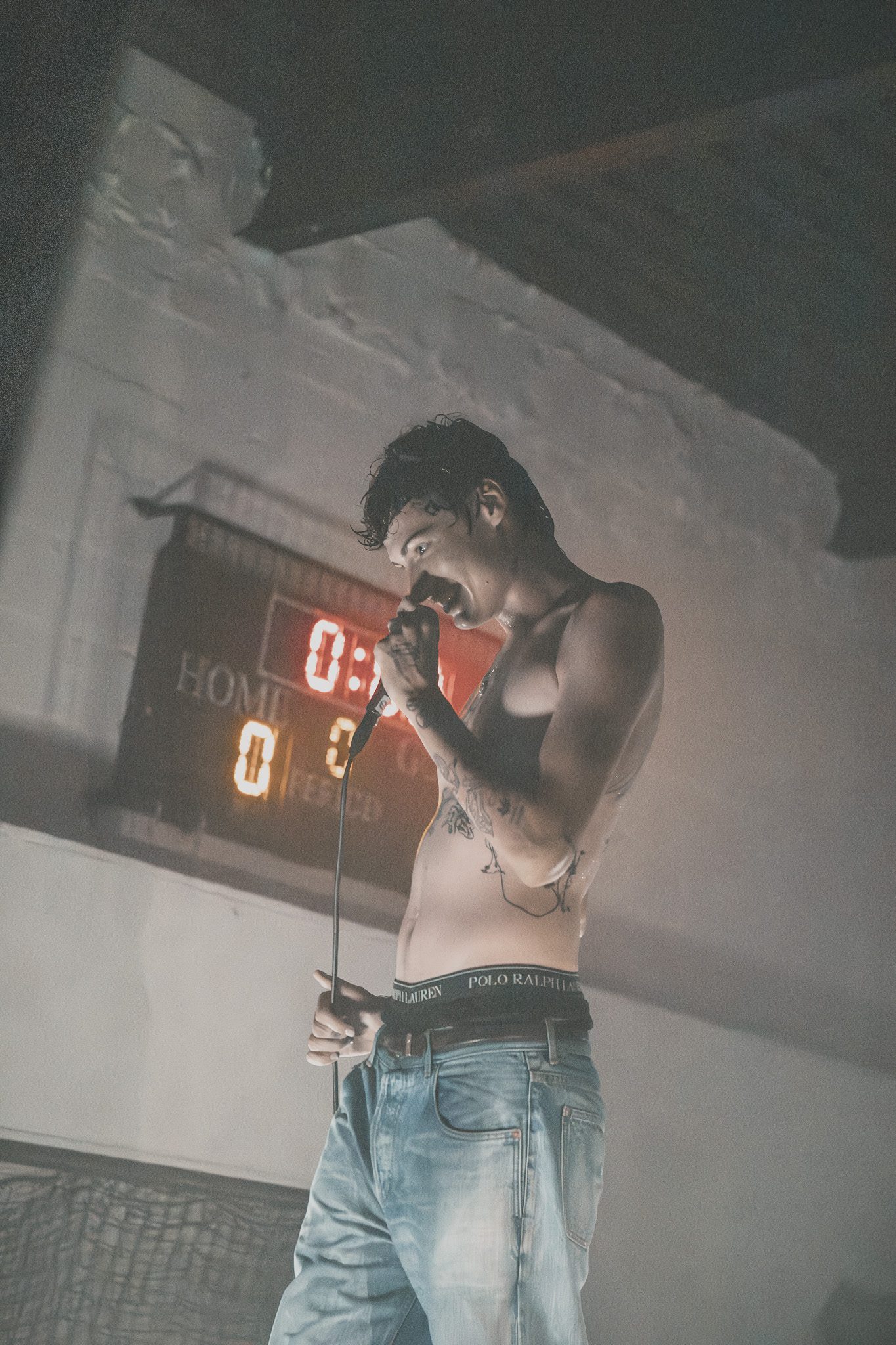
Y’all marks glaive’s third full-length release and, even in its infancy, it already feels like his most complete statement yet. Where past record leaned heavier into melancholy, this one charges forward with a haste that demands motion, that insists its heartbreak and nostalgia be danced through rather than simply endured. It’s a coming-of-age soundtrack, rooted in the soil of North Carolina, “Asheville” as both compass and confession, but expanded into something bigger: anthemic, intentional, and deeply alive. At only twenty, glaive positions himself not just as a figure of hyperpop, but as a storyteller shaping his own mythology. With Y’all, he’s charting a trajectory that feels less like fame and more like cult legend, every song threaded into a narrative that refuses to be ignored.
“Asheville” doesn’t just open the record; it throws us straight into glaive’s bloodstream. The song beats like a heart caught between resentment and reverence, bitter nostalgia dissolving into the rush of moving forward. Synths flicker like neon lights on a rainy street, pulling us into a digital landscape that feels both restless and alive. It’s an entrance that refuses subtlety: EDM flourishes collide with confessions about his hometown, and suddenly you’re watching glaive wrestle with memory in real time.
As the album’s lead single, dropped months earlier in July, “Asheville” set the tone for what Y’ALL would become: a coming-of-age diary disguised as a rave. And at The Ground in New York City, that truth was undeniable. Fans didn’t just sing along; they screamed every line as if they’d lived them, bodies colliding into mosh pits that spun themselves into dance circles, pure chaos disguised as joy. For two minutes and thirty-eight seconds, the floor belongs to glaive and the crowd equally, each fueling the other in a loop of reckless energy. If “Asheville” was meant to be a teaser, it didn’t just hint at what was to come: it set our teeth on edge with anticipation, left us wired, buzzing, hooked in the best way possible.
“Appalachia” barrels forward without pause, carrying the same current as “Asheville,” but with a sharper edge, a pulse that refuses to loosen its grip. The beat is urgent, wired, like a car engine redlining on the interstate, and glaive’s delivery mirrors that momentum: breathless, unapologetic, relentlessly forward. It’s a track about arrival: not just fame, not just success, but the surreal tension between leaving Buncombe County behind and still carrying it everywhere he goes.
The chorus makes no effort to hide where his heart belongs, name-dropping the Appalachian mountains, weaving his hometown into the mythology of the story. Yet the verses spill with the anxieties of recognition: the look he gets when he returns, the second-guessing when strangers ask if he does music, the assumptions tied to the car he drives. Fame, here, is not celebrated so much as dissected – a mirror of insecurities wrapped inside flexes of hard-won independence. And then there’s the outro, punctuated with the voice of Marvin “Popcorn” Sutton, the legendary Appalachian moonshiner. It’s more than a sample; it’s an invocation, tethering the song to the wild, stubborn spirit of North Carolina itself. By including Sutton, glaive ties his modern hyperpop rush back to the outlaw grit of his state’s folklore, making it clear he hasn’t abandoned his roots; he’s rewriting them into a new chapter.
At The Ground, “Appalachia” didn’t just keep the energy alive after “Asheville. It escalated it, sending bodies into one another like storm waves. The song begged for chaos, demanded dancefloor combustion, and the crowd answered with unrelenting fervor.
“Nouveau Riche” slides in like a gear shift, easing back from the pounding urgency of the first two tracks into something looser, smoother, but no less commanding. glaive threads reggaeton rhythms through his hyerpop fabric, creating a buoyant groove that feels as unexpected as it is authentic – a sound that proves he’s not afraid to clash genres until they spark. The lyrics keep circling back to the album’s spine, the story of ascent, of making something out of nothing, of wealth as born armor and alienation. On the floor at The Ground, the ambiance shifted; the chaos of mosh pits gave way into swaying bodies into two-step movements, the kind of collective release that made the track less about flexing and more about celebrating the climb.
“Fuck” is the album’s beating heart: fragile, unguarded, and quietly alive. It opens like a whispered secret between lovers, that same soft chemistry we heard on 2023’s “tiziana,” before spilling into something heavier, a slow-motion ache that feels both intimate and infinite. glaive’s voice drifts through layers of humid synths and guitar haze, capturing that dizzy feeling of loving someone so hard it unravels you. It’s heartbreak rendered as devotion, as if he’s saying the only language left is the one we invent mid-collapse. At The Ground, the track became almost ceremonial – when sound issues hit, the crowd took over, singing the lyrics back into existence before glaive rejoined for a second run, this time from the pit itself. It wasn’t just a performance; it was a reunion, a shared pulse between artist and audience that blurred every line between stage and floor, proving that “Fuck” is more than arguably the most popular track on the album; it’s the moment glaive’s story finally felt complete, he’s no longer reaching, he’s standing on the pedestal.
“Bluebirds” drifts in like a deep breath after consistent chaos, a song that trades motion for meaning. It’s quiet but not empty – the kind of stillness that hums beneath the surface, where honesty feels heavier than sound. glaive lets go of the dancefloor here and reaches instead for connection, turning his gaze outward, speaking to the people who orbit him: friends, fans, versions of himself that still feel lost. The track glows with the same soft melancholy as “ive made worst mistakes,” but this time the perspective has widened; it’s no longer a private confession but a hand extended. His voice glides over the verses like flight itself, fragile yet certain, reminding us that pain doesn’t always need to be fixed, sometimes it just needs to be seen. At The Ground, “Bluebirds” felt like a shared inhale, the crowd swaying instead of shouting, every lyric landing like advice from someone who’s surived the storm and wants you to know the sun still rises.
“Veni Vidi Vici” is glaive at his most self-assured; a declaration dressed as a confession, beating with defiance and clarity. Translating to “I came, I saw, I conquered” the phrase becomes less a boast and more a battle cry for survival, a mantra carved out of late nights, long drives, and the uneasy balance between ambition and authenticity. The track burns with metallic confidence, its beat shimmering like city lights reflecting off a windshield at 2 a.m. Beneath the swagger, though, there’s exhaustion, the recognition that success isn’t victory if it costs your sense of self. He pays homage to Avicii, to the ghosts of the artists who built him, and contrasts that glow with the emptiness he feels among those chasing fame for its own sake. In his refusal to become “anything like y’all,” glaive plants his flag – not in the industry, but in himself.
“We Don’t Leave The House” plays like a confession disguised as a club track – a dance song for people who never quite make it out the door. Over a buoyant, shadowed beat, glaive turns social anxiety into poetry, sketching the push and pull between wanting to belong and needing to retreat. His lyrics unravel like late-night thoughts: the fear of losing control, of doing something you can’t undo, of being seen too clearly under flashing lights. The song feels claustrophobic at first, looping around its refrain like a nervous tic, but then something shifts: the beat opens, the melody exhales, and glaive steps into the world he’s been avoiding. Even so, there’s no clean resolution; by the final chorus, he folds back into himself, choosing solitude over spectacle. It’s brutally self-aware, but also strangely comforting – a reminder that sometimes survival looks less like showing up and more like knowing when to stay home.
“Foreigner” feels like glaive looking at himself through a funhouse mirror: distorted, dazzling, a little disorientated, but truer for its reflection. The track pushes deeper into the electronic heartbeat of Y’ALL, where trap percussion meets hyperpop glamor, and his voice threads through the rush like static electricity. The entire album encompasses his upbringing in North Carolina, but this song shifts the lens, discussing his brief time in Florida during infancy. There’s a duality here: the swagger of someone who’s finally made it colliding with the unease of never quite belonging. The beat races forward, but the lyrics stay grounded in that strange loneliness that follows recognition, when home no longer feels like home and success feels foreign even to the one living it. His “for real” refrain, the moment he’s said to love most musically on the whole album, lands like a pulse check – proof that underneath the flexes and designer names, there’s still a kid from Florida trying to make sense of the distance between who he was and who he’s become. “Foreigner” doesn’t resolve that tension; it revels in it, spinning displacement into rhythm until it sounds almost euphoric.
“9” is the album’s breaking point, the moment where bravado dissolves into bare truth. The title’s simplicity feels deliberate, like a page left half-written, a chapter he’s not ready to explain. The production hums with a meditative melancholy, pulsing in slow motion as if the song itself is holding its breath. glaive doesn’t spell anything out; he circles regret like a ghost he can’t name, the lyrics landing in fragments that sound more like aftermath than confession. There’s a refile, there’s guilt, there’s the quiet admission that cycles never really end – they just blur into the next verse. What makes “9” so haunting is its restraint; he doesn’t plead for forgiveness or redemption, only recognition. It’s a song that feels like standing in the dark with your mistakes, tracing their outlines until they start to look like you.
“It Is What It Is” crashes in like a jolt of caffeine after the album’s darker introspection: brash, quick-witted, and bursting with the confidence of someone who’s finally stopped apologizing for his evolution. It’s glaive stepping fully into his trap era, word tumbling over each other with the speed and swagger of someone testing how far his tongue can run before his breath catches. The beat still hums with hyperpop distortion, but it’s coated in grit now, bending toward something sharper, heavier. Beneath the humor and punchlines, though, sits a quiet melancholy – the laughter that doesn’t quite land, the joke that’s really a mask for exhaustion. It’s a self-portrait in quick strokes: equal parts bravado and burnout.
“Modafinil” feels like the album’s lucid dream – everything sharp, shimmering, and slightly unstable. The track pulses with the restless heartbeat of someone trying to outthink their own spiraling thoughts, chasing focus in a haze of overstimulation. What began as a solo cut becomes far larger; Kai’s Russian verse folds into glaive’s English ones like reflections in a mirror, adding texture and mystery, while Kurtains slides in with an effortless cool that turns the song into a full-spectrum collaboration. The beat itself feels generational: house-inspired, hypnotic, dark in tone, but intoxicating in movement. It’s a soundtrack for both burnout and rebirth. Beneath the rhythm, glaive’s lyrics circle themes of control, self-doubt, and identity, his voice teetering between confession and collapse. At The Ground, when Kurtains joined him on stage, the room cracked open – the kind of performance that feels suspended in air, impossible to replicate. “Modafinil” doesn’t just sound like the future of glaive’s sound; it feels like it. It’s chaotic, transcendent, and beautifully human.
“Polo Ponies” turns the album on its head – a soft detour down a dirt road after miles of neon blur. It’s the most unexpected moment of Y’ALL, yet somehow the most intimate, a quiet country-tinged confession that feels like watching the sunrise through the rearview mirror. glaive trades distortion for tenderness here, his voice steady but grayed at the edges, singing like someone trying to make peace with where he came from. The twang sits gentle beneath his usual electronic palette, not as a gimmick but as a homecoming, grounding the album’s digital chaos in something human and handmade. Lyrically, it’s drenched in gratitude – for love, for family, for the ghosts of his hometown – but it’s the closing line, “I thank God for you the most,” that lingers like a sigh. “Polo Ponies” feels like a love letter written in lowercase, proof that even in reinvention, glaive never forgets his roots; he just keeps finding new ways to sing to them.
“i love you and it sounds stupid” is the emotional apex of Y’ALL – a love song so sincere it almost feels forbidden in its vulnerability. There’s no irony here, no clever disguise; just glaive, raw and unguarded, letting sentiment spill where perfection used to stand. The title alone reads like a defense mechanism, an apology for feeling too much, and that’s what makes it hit so hard. The literary nod to “The Unbearable Lightness of Being” deepens the ache; a meditation on love’s fragility, on how devotion and foolishness often share the same breath. Musically, it unfolds with the grace of a confession whispered in a dark room, every note deliberate yet trembling. It’s the kind of song that disarms you – not because it’s grand, but because it’s honest, simple, and completely unafraid to sound foolish for the sake of love. This is glaive at his purest: no filters, no bravado, just a boy saying “I love you” and meaning every syllable.
“Crying, Laughing, Loving, Lying” plays like the emotional afterimage of “i love you and it sounds stupid” – the love song’s echo once the light comes back on. It’s jittery, vulnerable, and brutally self-aware, the sound of a restless mind trying to untangle tenderness from fear. The production wobbles between pulse and pause, like a heartbeat caught mid-anxiety attack, giving shape to the chaos that lives between overthinking and feeling too much. There’s no disguise in the writing: it’s spontaneous, raw, almost stream-of-consciousness, and that’s what makes it so magnetic. When glaive mutters “Jeff told me once or twice I just need to relax,” it lands less like advice and more like a cruel joke – because he can’t, and he knows it. Still, beneath the spiral there’s an honesty that feels grounded: the admission that love, worry, and self-doubt can coexist, that maybe they always do. “Crying, Laughing, Loving, Lying” isn’t about balance; it’s about the art of staying afloat while the current keeps pulling you under.
“Weird” feels like a final shrug in the face of everything – fame, change, expectation – a song that wears its rawness like armor. There’s no polish here, no disguise, just glaive holding up a mirror to the absurdity of it all and refusing to flinch. The beat rattles loose and unfiltered, like something record in a fever dream and sent straight into the world before self-doubt could catch it. It’s his southern roots meeting his modern myth, his reminder that you can leave your hometown, but it’ll always stick with you, no matter how far you go. The repetition of “it’s weird” becomes both mantra and mockery – a laugh in the face of scrutiny, a warning not to mistake transformation for loss. There’s courage in how unfinished it feels; it’s the sound of an artist no longer trying to impress, only to exist. In the simplest terms, “Weird” is glaive closing the curtain without bowing: still himself, still unpolished, still beautifully strange.
“Bennie & Kay” closes Y’all like eulogy whispered into the stars: tender, unguarded, and devastatingly human. It’s glaive at his most vulnerable, trading the digital pulse of his world for something eternal, something that lives in the quiet between loss and remembrance. The song unfolds like a letter written to the afterlife, his words trembling between faith and grief as he speaks to his grandparents: to the love they carried, the space they left behind, the inheritance of pain that shapes what it means to keep living. The chorus asks the unanswerable – “is it better upstairs? does it feel like home?” – questions that hang in the air long after the final note fades. When his grandfather’s voice surfaces in the outro, it feels like the universe itself is answering back, gently closing the door. At The Ground, glaive apologized for his tears, but glinted in the eyes of every audience member that stood still, silent. It’s an ending that doesn’t seek resolution but reverence, a final bow to those who made him and a quiet promise to carry their memory forward. “Bennie & Kay” doesn’t just finish the album; it sanctifies it, turning Y’all into a living memorial for love, loss, and the fragile beauty of still being here.
Y’all feels like standing in the eye of a storm: chaotic, luminous, and strangely peaceful once you surrender to its pull. At its center is glaive, carving out a home within his own sound, finding sancutary in the noise he once tried to outrun. Across sixteen tracks, he writes with unflinching honesty, baring every nerve while still chasing beauty in the wreckage. It’s an album that breathes, that fractures, that rebuilds – proof that growth doesn’t come from safety, but from daring to lose yourself entirely. Y’all isn’t just a collection of songs; it’s a compass pointing toward everything glaive is becoming. If this is where he’s starting, the horizon ahead is boundless – an unfolding map of what it means to be young, restless, and fearless enough to keep evolving.
Leave a Reply