
Some records ask to be played. Others ask to be heard.
With the release of the limited-edition 12-inch vinyl for “Pretrial (Let Her Go Home),” Fiona Apple offers something heavier than music and more permanent than outrage. This is not a keepsake meant to sit politely on a shelf. It is a document. A witness. A hand reaching out with the turntable, insisting that we look longer and listen harder.
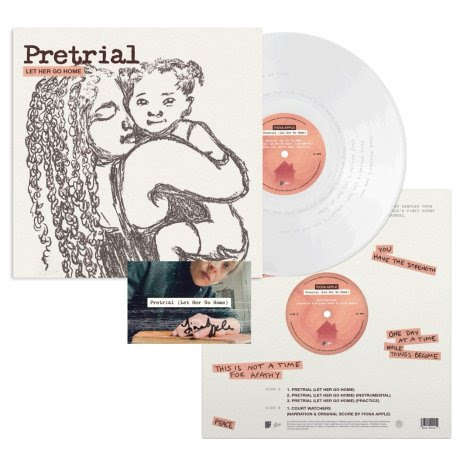
Pressed in highly collectible form, the vinyl release deepens the world of Apple’s devastating protest anthem – an unflinching portrait of how the broken cash-bail system fractures lives, families, and futures, disproportionately harming Black mothers who are jailed not because they are guilty, but because they are poor. At least seven dollars from every record sold will go directly to Let Her Go initiatives, making each purchase a tangible act of resistance.
The physical object itself feels intentional in every detail. The record is etched. The sleeve is engraved. The cover art, drawn by Apple’s own hand, feels raw and personal, like something pulled straight from a notebook rather than polished for consumption. Tucked randomly inside select pressings are signed photo cards, quiet surprises that feel less like merch and more like a thank-you note slipped into a library book.
But it’s the audio that cuts deepest.
Alongside the original song, the vinyl includes an instrumental version and a stripped-down “practice” take that leaves Apple’s voice exposed, vulnerable, and unguarded. Flip the record, and Side B shifts the perspective entirely: “Court Watchers (Narration & Original Score by Fiona Apple),” a piece created in connection with the National Courtwatch Network, urging everyday people to sit in courtrooms and observe what too often goes unseen. Justice, Apple reminds us, depends on witnesses.
The song itself grew out of Apple’s years spent court-watching with CourtWatch PGH, where she saw the same story repeat with numbing regularity: mothers detained pretrial, separated from children, jobs lost, rent unpaid, lives unraveling while innocence remains legally intact. The lyric that anchors the song lands like a punch to the chest: “They wouldn’t let her go home, and now there’s no more home.” No metaphor. No flourish. Just the truth.
Earlier this year, the accompanying music video made that truth visual. Built from thousands of personal images submitted by women who survived pretrial detention – family snapshots, graduations, birthday candles, laughter frozen mid-moment – the video slowly erases those memories as Apple sings. Faces glitch. Rooms disappear. The losses compound until absence becomes the loudest presence in the frame. It is devastating precisely because it is ordinary.
This vinyl release continues that work. It doesn’t soften the image. It doesn’t aestheticize suffering. Instead, it asks for proximity, for listeners to sit with discomfort, to hold the weight in their hands, to understand that systems fail people quietly, every day.
Apple has always made music that refuses to behave. From Tidal to Fetch the Bolt Cutters, her work has pushed against expectation, politeness, and the idea that art should exist separately from consequence. “Pretrial (Let Her Go Home)” may be one of her most urgent statements yet, not because it is loud, but because it is precise. It names what is happening. It shows the cost. It asks what you will do next.
This record spins at 45 RPM, but its impact doesn’t move in circles. It moves outward – into courtrooms, into communities, into the quiet places where injustice usually hides.
Drop the needle. Then don’t look away.
Leave a Reply