
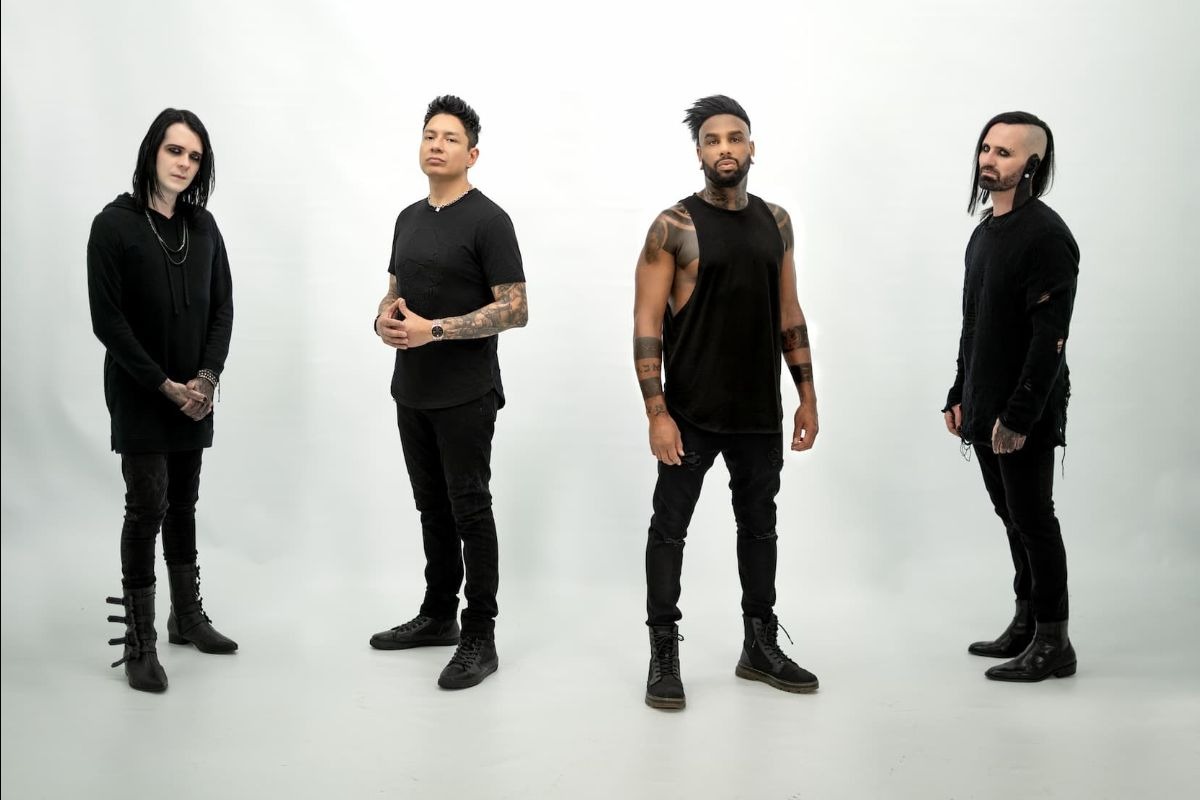
There are bands that chase reinvention like a costume change, something worn briefly beneath stage lights before being folded away into suitcases backstage. And then there are bands like The Veer Union, who treat reinvention less like transformation and more like survival. Not an erasure of the past, but a slow turning of the wheel, steady hands gripping the steering wheel as the road bends somewhere unexpected.
Speaking with frontman Crispin Earl feels less like an interview and more like brushing the dust off of metalcore’s history textbook. He introduces himself plainly, but far from simply, holding the ambition of someone who has only grown more infatuated with his craft as the clock has ticked on: “My name is Crispin, I’m the singer, songwriter, producer, record company, most of the time, for The Veer Union.” His introduction lands with quiet humor, but also truth: a life lived wearing too many hats because the music demanded it.
He laughs about it easily. “I wear many hats, yes.” Behind the joke sits decades of persistence, the kind built not from overnight breakthroughs but from endurance: long highways, broken expectations, and the stubborn refusal to stop creating.
Every band has an origin myth. The Veer Union’s begins not in a studio, but in a school gymnasium, somewhere between childhood awe and destiny forming quietly.
“I remember distinctly, I was 10 years old, and the high school band came to my school, and I remember seeing the drummer playing, and I was like, wow, I’ve never seen anything like it before… this is what I want to do.”
The moment reads like a cinematic flashback: fluorescent lights humming overhead, a drum kit echoing louder than anything a ten-year-old had ever heard before. Drums came first. Voice came later, almost accidentally.
“I was playing drums in a few different bands, and none of the singers could sing in key. I finally was just like, I’m pretty sure I could maybe do that better.”
And just like that, the person behind the rhythm stepped forward into the spotlight.
The band itself was born from disillusionment — a necessary fracture. After difficult experiences within the industry, Crispin returned home carrying equal parts exhaustion and clarity.
“I came back, and I was like, I want a fresh start. I started writing and producing myself… That was the beginning of The Veer Union.”
The name was never accidental: “Veer means to change direction. I wanted to change direction with a bunch of people… I wanted to veer away from where we were going, have a union, and be one.” It sounds less like branding and more like a promise — a collective decision to choose passion over profit, connection over calculation.
Their upcoming record, Reinvention, doesn’t arrive as a rebirth. Instead, it feels like a sharpening — metal forged hotter, heavier, more honest with time. Crispin doesn’t overembellish: “We weren’t reinventing the wheel… for us, it was very much like reinventing ourselves.”
Where many bands soften with age, The Veer Union moved in reverse: “Usually bands… start off heavy and then they get softer… but we’ve done exactly the opposite all the way through our career.” The world grew louder, harsher, more chaotic — and their music followed suit. Yet beneath distortion and aggression remains the same emotional core: struggle searching for hope.
“There’s always been struggles. And in those struggles, you try to find hope. And that’s very much what this record’s about.”
The band’s history is marked by moments where instinct battled industry expectation. During their early label years, singles were chosen for marketability rather than authenticity, decisions Crispin resisted fiercely: “If you do that, then we’re going to lose our identity fully and completely.”
When the label ignored his warning, the results confirmed his intuition. That realization reshaped everything: “That was kind of the beginning for me that made me realize, I think I know my own brand… better than a major label. So I started my own label and life has been much better since.” It’s a turning point that echoes through the band’s philosophy today: autonomy as survival.
If Reinvention has a thesis, it isn’t sonic experimentation; it’s mental liberation. “Just don’t listen to the outside chatter, just listen to your inner voice,” Crispin underpins it all.
The album grew slowly, deliberately, almost defiantly in an era obsessed with singles. “We were thinking about it as an album… We want people to listen to the whole album from front to back.” Ten songs. One emotional arc. No shortcuts.
And when asked what listeners should carry away after hearing it all, Crispin answers with disarming simplicity: “Never give up.”
The conversation turns quieter when discussing burnout, the moment after being dropped from a label, when music briefly disappeared from reach: “I went out and got a day job for about three weeks… I remember thinking… this is not why I was put on earth.”
The band’s album Life Support wasn’t metaphorical; it was literal. “I felt like I was so lost… and now I just don’t let myself get back into that spot because I’m still doing music.” Every morning since has carried gratitude instead of doubt. “I’ve already achieved the goal… I’m making music from the heart, and I’m doing what I love doing.”
After more than a decade of releases, charting singles, and shifting industry landscapes, the band’s ambition feels almost humble. “I’d like them to remember it as… proof that a band that never gives up can continuously evolve.” Not dominance. Not fame. Just persistence.
Their immediate dream is even simpler: returning to the stage — “I just really hope that we can get back out and tour off this album… that’s the number one goal.” Because for all the streaming numbers and studio hours, live music remains the heartbeat.
Before the conversation ends, Crispin leaves listeners with something refreshingly analog in a digital age: “It’s actually us talking [on Instagram]… we still believe in actual human connections.”
And maybe that’s the real reinvention — not heavier guitars or sharper production, but returning to something older than the industry itself: people making music because they have to, because silence feels impossible.
The Veer Union never stopped moving forward. They simply learned when to veer and redefine what music means to them, not only as a career but as a lifeline.
Reinvention releases tomorrow, February 20, 2026, on all streaming platforms. Pre-save HERE.
Leave a Reply