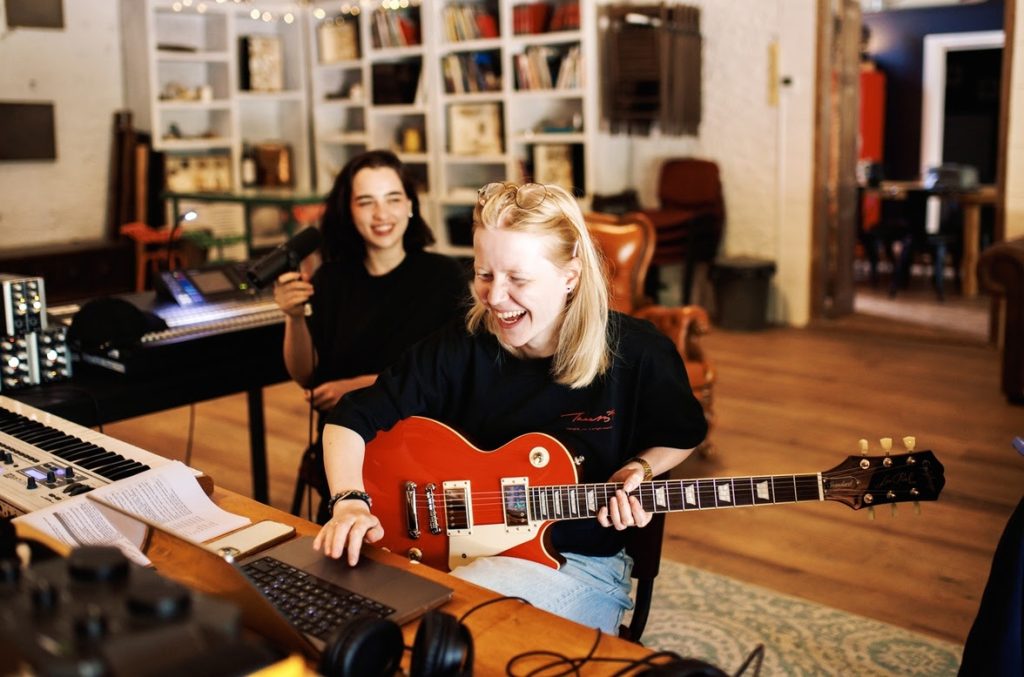
Amplify Arts Project and Push-Up Bra LA will be introducing their Amplify Arts Project x Push-Up Bra LA Writers Camp that will give early songwriting access to teenage girls to experience professional writing rooms and mentorship with female artists in the industry. The writing program will give empowerment to young girls to build confidence, community, and creativity through music.
The writing program will be from June 15 – 19, 2026 and there will be ten young songwriters ranging from 14 -19 that will be alongside filmmakers for a week of creative collaboration. The young participants will experience daily writing sessions with professional producers and songwriters, learn the aspects of the music industry, and record music in professional studios to give them that full immersive experience. There will be a collaborative EP release in the Fall of 2026 that will be also have a live release show in Los Angeles.
There will be a documentary filmed over the next two years that will be following four Writers Camps empowering the next generation of young women through music. The documentary will tap in the gender imbalance in the professional spaces and how mentorship as well as early access to these experiences will help reshape the future of the music industry. There will be five young filmmakers that will be part of the first portion of the documentary that will be filming the creative process and what unfolds inside writing spaces and recording studios.
Epitaph Records, BMI and CD Baby are currently the sponsors so far and additional partners will be announced in upcoming weeks
Amplify founder Jen Baron, Amplify Program Coordinator Devin Davis, and Push-Up Bra LA founder Zealyn are teaming up to be able to give access to young inspiring girls to be able to experience the creative process in the music industry.
Amplify Arts Project has empowered more than 15,000 young creatives through music and arts programming focused on building confidence, creativity, and community among girls and young women
Applications for the Writers Camp will run from April 1 – 15 on the Amplify Arts Project’s website
Interviewer: How did the two organizations (Amplify and Push-Up Bra LA) become connected and intertwined on this project?
Zealyn: “Amplify and Push-Up Bra LA came together really organically — over a cup of coffee. Devin and I [Zealyn] talking about the importance of giving young girls hands-on education in music studios and writing sessions before they ever have a chance to feel the inequity of the music industry. Once we started talking, it became clear that our missions deeply aligned. Together, we could build something neither of us could do alone. It felt less like a partnership and more like a natural extension of work we were both already doing.“
Interviewer: What is unique about this program, and why is it important for young girls in songwriting spaces?
Zealyn: “Most music programs for teens are performance-based — you learn an instrument, you play a recital, maybe you’re in a band. This is different. We’re replicating what an actual professional songwriting room looks like: a small group of writers in a room together, building a song from scratch, understanding how ideas come alive through production, how collaboration works, and how you advocate for your creative voice when you’re surrounded by other strong voices. These are skill that typically take years to develop.
This matters significantly for young girls because the music industry can be an incredibly unsafe environment for women. Harassment and discrimination are not rare exceptions; they’re experiences a staggering number of women in this industry have faced firsthand. When you enter those spaces without confidence, without knowing your worth, or without understanding how the room works, you’re vulnerable in ways that go beyond just your career. The earlier a young woman can build that foundation, the better equipped she is to recognize when something is wrong, advocate for herself, and move through the industry with a sense of her own power. We’re not just teaching songwriting. We’re teaching young women how to take up space, and how to protect themselves while they do it.“
Interviewer: What has been the most eye-opening or difficult experience as a young woman in songwriting spaces? What barrier do you hope to break down?
Zealyn: “I think the most persistent barrier isn’t always obvious — it’s subtle. It’s the unspoken pressure to be likable, to not take up too much space, to not fight for your credits, to be grateful just to be included. That’s the barrier I want to dismantle — the internal one. The most dangerous thing is when young women internalize those dynamics and start shrinking themselves before anyone even asks them to. I hope this program gives girls a chance to practice being fully themselves in a creative space, before the world has a chance to convince them to be less.”
Interviewer: What is the most meaningful thing you’ve learned from a mentor?
Zealyn: “There’s something that shifts in you when someone who has navigated this industry successfully looks at you and says, you belong here. It sounds simple, but it’s profound when you’ve spent years second-guessing yourself. On the industry side, I think one of the most gatekept things is just how the business of songwriting works — publishing splits, how cuts happen, what it actually means to have ownership of your work. So much of that information lives in relationships, not in any textbook. That’s part of what we want this camp to demystify. Knowledge is power, and for too long that knowledge has been passed down selectively.“
Interviewer: Elaborate more on the nonprofit? What inspired you to start this organization and what has been the most rewarding part of running it?
Zealyn: “Push-Up Bra LA was born out of a very real frustration with the lack of paid opportunities and genuine support for women in music. I wanted to build something that didn’t just celebrate women but actually created infrastructure for them — real, tangible opportunities that move careers forward. We do that through live music events, songwriting camps, content creation, networking events, and mentorship, all designed to give women in music visibility and income at the same time.
The most rewarding part is watching that work actually land — seeing an artist get paid well to perform an acoustic set, or walk out of a writing camp with a song and a new collaborator, or gain visibility through content that tells her story.
When we connected with Amplify Arts Project, I was genuinely moved by the depth of their passion and the meaningfulness of their programming. They’ve spent over a decade building something real for young women in music, and that kind of commitment doesn’t go unnoticed. That’s exactly why we are so thrilled to be working with them on this!“
Interviewer: What is the secret to building confidence? What should every girl remind herself of in rooms where others make her feel she doesn’t belong?
Zealyn: “I think the secret is repetition in safe spaces. Confidence isn’t something you find and then have forever. It’s something you build by doing the thing, even when it’s uncomfortable, and then doing it again. That’s part of why the structure of this camp is so intentional. We’re not doing a one-day workshop. We’re giving these young women a full week of showing up, creating, being heard, and building evidence for themselves that they can do this.
And if there’s one thing I’d want every girl to remind herself in a room that makes her feel small, it’s that her discomfort is not proof that she doesn’t belong. It’s proof that she’s brave enough to be somewhere new. The people who built those rooms weren’t more talented than you. Many of them just got there first, and had more people along the way telling them they were supposed to be there. You are supposed to be there. Your ideas are worth the room’s time. And the industry needs your voice, not a version of it that’s been edited down to make other people comfortable.“
Interviewer: What legacy do you hope this program and your nonprofit leave?
Zealyn: “I hope our mentorship focused writing camps can help shift the future of this industry. More women in writing credits. More women producing. More women in A&R, in publishing, in the rooms where the industry is shaped. And I hope that twenty years from now, one of the young women who went through this camp is leading a label, or winning an award, and that she’s mentoring someone else. That’s the cycle I want to set in motion.
For Push-Up Bra LA and Amplify Arts Project, our legacy is to have built something that lasts — a real institution that supports women in music at every stage of their career.“
Interviewer: With the application process; how does the organizations decide on what applicants will be participating in this project?
Zealyn: “We take the selection process really seriously, because we know that for many of these young women, this could be a pivotal moment. We’re looking for a combination of things — creative potential, genuine passion for songwriting, and an openness to collaboration. We’re not just looking for the most polished writers or the most experienced musicians. Some of the most compelling voices in music came from people who hadn’t yet had the opportunity to develop their craft in formal settings. So we’re looking for potential and heart as much as we’re looking for existing skill.“
Interviewer: How do you ensure participants feel emotionally and physically safe, especially those who arrive with anxiety or low confidence due to how society treats them?
Zealyn: “Safety is foundational. Without it, creativity doesn’t happen. We’re very intentional about the environment we create from day one. That means making sure every facilitator and mentor in the room has been vetted, that we establish community agreements together as a group at the start of the week, and that there are clear channels for participants to express discomfort without fear of judgment.
We also build in structure that gradually increases in vulnerability. There’s a welcome, trust-building, small workshops throughout, and a whole process. And we make sure these young women know that not finishing a song, saying the wrong chord, sharing an idea that doesn’t land — none of that is failure. That’s just writing. Creating a culture where imperfection is part of the process is one of the most important things we can do for a young artist’s long-term relationship with their own creativity. I wish I had learned this at a younger age.”
Interviewer: Why is music such a powerful outlet for young women navigating their teenage years?
Zealyn: “Because it gives language to things that don’t have words yet. Being a teenage girl or a young woman involves incredibly complex emotional experiences. You’re figuring out who you are while the world tells you who you’re supposed to be, and those two things often conflict. Music creates a container for that tension. It says: this feeling is real, it’s worth expressing, and you’re not alone in it.
Songwriting in particular gives young women agency. You’re not just consuming someone else’s story — you’re creating your own. And in an age where so much of a young woman’s self-worth is tied to how she’s perceived externally, the act of going inward and creating something from that place is genuinely radical. It builds a relationship with yourself that no one can take away.“
Interviewer: What does it mean to watch a young woman realize her voice deserves to be heard in an industry that’s filled with toxicity and that’s male dominated?
Zealyn: “It’s the whole reason. It’s why I do any of this.
There’s a specific moment (and if you’ve witnessed it, you know exactly what I’m talking about) where something shifts in a young woman’s face when she realizes that what she just created matters. That her perspective is not too much, not too niche, not too feminine, not too anything. It’s just hers, and that makes it valuable. Watching that happen in real time, in a room that was designed to hold space for it… that’s indescribable.
The music industry can be brutal, and it has a particular kind of brutality reserved for women who are both talented and opinionated. So when I get to be part of the environment that helps a young woman build her foundation before she faces that (before the industry has had a chance to chip away at her) I feel like we’re doing something that actually matters. We’re not just making music. We’re building women who know their worth before the world tries to knock it down.”

Leave a Reply