
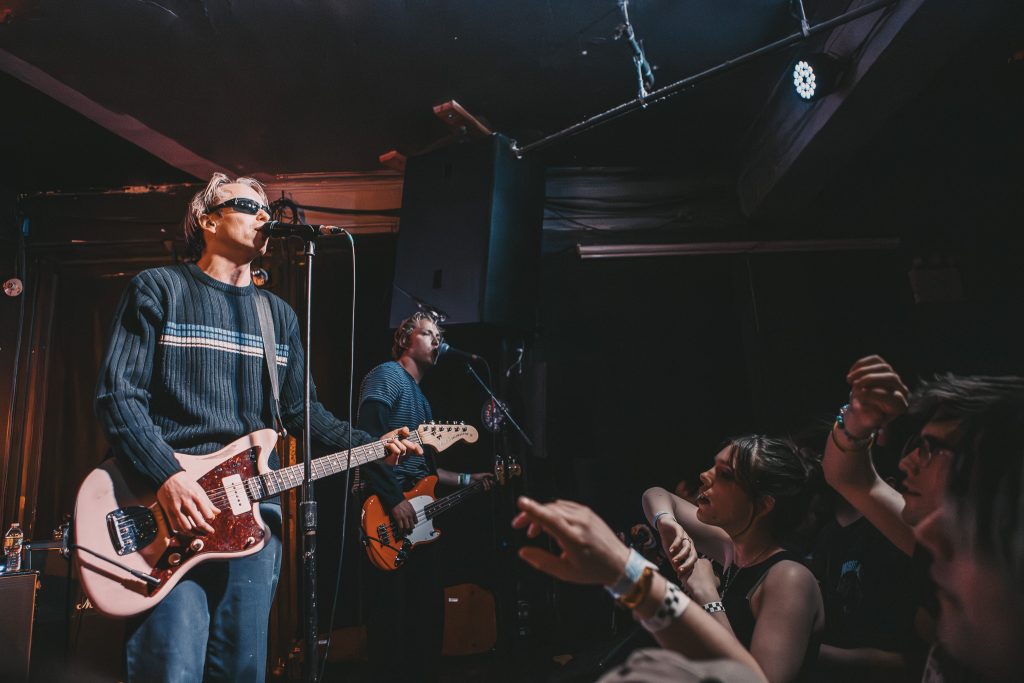
This past Saturday, Market Hotel seemed to inhale, brace, and then give way — buckling just slightly — as SWMRS tore into a night that felt less like a show and more like being pulled along a long, familiar road. They’ve always belonged to the sprawl of Oakland, California, but something in the room suggested otherwise, like the city had been waiting with the lights on. In a way, it had. So much of Drive North was born here, stitched together in the New York air, and after three years of silence between them and this city, the anticipation wasn’t just loud; it was restless. The crowd met them head-on, catching every jagged riff, every low-end pulse, every drum crack that ricocheted through the room. If anything settled by the end of it, it was this: New York hasn’t forgotten them, and it shouldn’t have to wait this long again.
A debut record is an intimidating kind of exposure, like stepping into harsh light and trusting your shape will hold. In 2016, SWMRS did exactly that with Drive North, a first statement that didn’t ask for permission. It spread quickly, passed hand to hand, speaker to speaker, until it embedded itself somewhere deeper than charts could measure. Ten years on, it hasn’t dulled; if anything, it’s calcified into something sturdier — less a moment, more a fixture. It never needed commercial peaks to matter. It just stayed. Every track lands with intention, like it already knows where it belongs: a record without gaps, without filler, just one continuous current.
For me, it’s never been just an album. It’s a time capsule with the volume turned all the way up. Every listen folds the years in on themselves: I’m back in that car, windows down, driving nowhere in particular through a town that felt too small for the kind of leaving I had in mind. When the anniversary tour was announced, my phone lit up before I could even double-check the dates and venues: messages stacking, overlapping, echoing the same wonder. These were the same friends I’d once stood in line with for hours, pretending we were there for All Time Low, when really we were waiting for SWMRS to open, quietly convinced they were the better secret. Life has scattered us since — different schedules, different boroughs — but that night pulled us back into orbit. We found each other in the chaos, spun each other through the pit, shouted lyrics that had etched themselves into us at 12, 13, words we never really let go of. There was something mending in that, something subtle but undeniable. Music does that. It grows alongside you, reshapes itself, gathers weight.
They came on without ceremony — no build-up, no distance — like stepping back into a room you never quite left. “Hannah” hit first, all feedback and static, sound bouncing off brick and glass, even catching the blur of the subway slicing past behind the stage. It felt exactly the same and completely different at once. The edges sharper, the delivery steadier, but the core intact. The room moved as one organism, no hesitation, no stillness. Bodies surged like they’d been waiting for this exact release. From there, they moved through the record in sequence — “Harry Dean,” “BRB,” “Miss Yer Kiss” — each song another push forward, the crowd carried along like a tide that refused to settle.
Even with the set anchored in the anniversary, they threaded in moments that snapped the room wide open — “Hellboy,” “Trashbag Baby,” and the newer “Mexican Punks,” proof that they are still moving, still colliding with whatever comes next. During “Lose Lose Lose,” Cole dropped a command, and the entire crowd obeyed without question, sinking to the floor before erupting upward, unified, reckless, alive in a way that felt almost necessary. For a few minutes, it wasn’t just a crowd. It was something collective, something earned.
Certain songs hit differently — “Turn Up,” “Miley,” “Lose It” — the kind that stop being tracks and start becoming shorthand for who you were, who you still are. Hearing them now didn’t just confirm their lasting impact; it deepened it. But it was “D’You Have A Car” that split the room open. The death wall formed almost instinctively, the crowd parting like something ritualistic before crashing back together with full force. After that, the pit never really closed, just shifted shape, cycling between chaos and something almost joyful. People spun, collided, held onto each other. It wasn’t just aggression; it was release, rhythm, movement for its own sake.
They closed where they began, with “Drive North.” The final notes stretched out, looped, dissolved into a blur of motion — bodies turning, voices pushing past their limits. Cole kept coming back to it throughout the night, but he wasn’t wrong: there’s something singular about a New York crowd that knows every word and gives it back tenfold, louder each time.
Ten years of Drive North in 2026 feels almost unreal on paper, but inside that room, time collapsed. It didn’t feel like a decade. It felt immediate, unfinished, still in motion. Like we were all still somewhere in the middle of it, still “Figuring It Out,” still reaching for something just out of frame. I first heard it at 12. At 21, it hasn’t faded; it’s sharpened. The meaning shifts, but the impact doesn’t. That’s the mark good music leaves: it doesn’t age, it just follows you forward.
SWMRS | WEBSITE | INSTAGRAM | FACEBOOK | YOUTUBE


Leave a Reply