
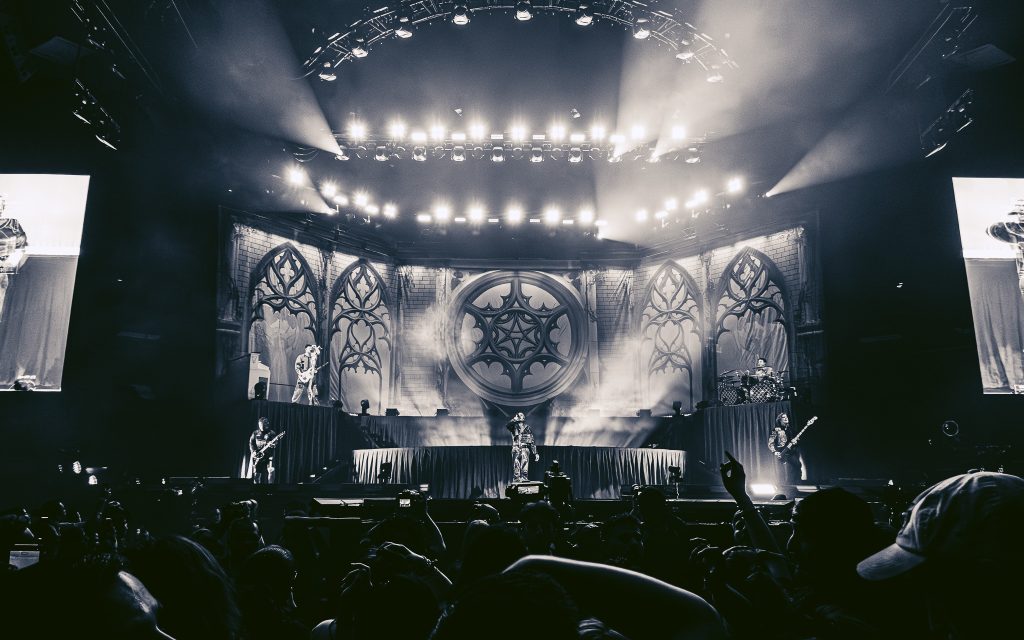
There is something miraculously marvelous about metalcore music finally holding space on arena stages, like something once confined to basements and dimly lit clubs now breathing beneath cathedral ceilings. This past Saturday, Madison Square Garden extended a hand, welcoming a night of beautifully controlled chaos from a bill that boasted heavyweights across the scene: rising melodic crooner Amira Elfeky, post-hardcore juggernauts The Plot In You, screamo staples Motionless in White, and, of course, the undeniably deserving headliner Bring Me The Horizon. For every artist, there is something meteoric about performing at The Garden — it is the most renowned room in Manhattan — but for Bring Me The Horizon, it felt less like a venue and more like sacred ground. This wasn’t just a performance; it was a culmination, a release, a moment where songs that once held our worst nights were reshaped into something almost redemptive.
There are few tour bills I come across where I know the discography of every artist front to back, where every set feels like it belongs to me in some small, personal way. So when Bring Me The Horizon announced their “Ascension Program” tour, I knew I would find a way into that room, from the first note to the final breath of the encore. I rushed out of my apartment 45 minutes before set times, despite a 15-minute commute, but New York thrives on the unpredictable. Train delays stretched time thin, and I arrived barely in time to catch the closing moments of Amira Elfeky’s set.
Truthfully, I was devastated in a way that stung. I had been itching to see Amira Elfeky since discovering her last spring while searching for female voices carving space in heavier scenes. As a Los Angeles-based artist, she rarely crossed into this side of the land, which makes every opportunity feel fleeting. I caught “Hold Onto Me” just in time, and even in that single moment, her presence filled the room effortlessly, her voice echoing with the same haunting clarity as the recordings I’ve looped on long drives. It felt like catching a glimpse of something just out of reach, enough to satisfy but not enough to settle my craving: I simply must witness a full Amira Elfkey set soon, and I’m certain she won’t remain my best-kept secret for much longer.
There’s something seamless about the way a night moves at Madison Square Garden, like a machine that is shiny and oiled. Set changes slip by almost unnoticed, each act stepping into place in exact minutes, the vigor never fully dissipating. When the lights rise, the room doesn’t quiet; it hums, charged with anticipation, something almost kinetic reverberating through the crowd. You can feel it from the floor to the rafters, that shared understanding that this isn’t just another show. It’s something you’re lucky to be inside of.
The Plot In You charged into that atmosphere with “Don’t Look Away,” pulling the room into something heavier, something more grounded after Amira’s haze. From the first verse, the crowd leaned in, completely locked, and we surely didn’t look away. The pit split open for the first time that night, and from there it never really closed, bodies colliding in waves that felt less aggressive and more communal. Their set was concise but deliberate, moving through “Left Behind,” “Forgotten,” and, my personal favorite in the setlist, “Divide,” before closing on “FEEL NOTHING,” while still carving space for something new with “You Get One” from their upcoming album, releasing in July. It felt like a shift in pressure, like the night exhaled and then immediately inhaled something sharper.
The lineup itself felt handcrafted, almost like a slow build toward something inevitable. Each set added weight, stacking emotion and intensity until the room was primed to rupture. Motionless in White carried that momentum forward, stepping in with a confidence that felt earned, not performed. Having toured alongside Bring Me The Horizon before, there was a familiarity there, but nothing about it felt routine.
For Motionless in White, this wasn’t just another tour stop; it felt closer to a homecoming. Hailing from Pennsylvania, the proximity alone gave the night a different kind of gravity, and they acknowledged it with candour, reflecting on the years they spent in the pews of this room, never expecting to stand on the stage instead. They moved through “Voices,” “Another Life,” and ended on a scene necessity “Eternally Yours” with a sense of purpose, like they were reliving every step that got them here. It felt like both a milestone and a beginning, the kind of moment where a dream becomes tangible and the impact becomes obvious.
Then the lights might’ve flickered back to life, but the stage itself slipped out of sight, concealed behind a curtain that fell heavy to the floor, stamped with icons and logos that have become synonymous with the band, layered beside elemental compositions that felt both scientific and sacred. The artists weren’t on stage yet, the house music still throbbed through the speakers, but the intention was already seeping into the room, slow and undeniable. The banner was scrawled with neurotransmitters and psychoactive compounds, visuals that on the surface tether to their current Post Human era, but underneath speak to something more unsettling. A thesis was first planned in POST HUMAN: SURVIVAL HORROR and expanded in POST HUMAN: NeX GEn, where humans are reduced to chemistry, thoughts distilled into code, identity suspended somewhere between flesh and machine.
It is arguably the band’s most ambitious conceptual work to date, but calling it a concept almost undersells it; it’s a fully realized world, one that extends far beyond the music and refuses to feel finished. The live show only reinforces that, proving this era is still evolving, still breathing, still mutating in real time. There is no better moment for Bring Me The Horizon to occupy arenas the way they always should have — this scale isn’t indulgent, it’s necessary. This is music that needs space to expand, to echo, to exist at full capacity.
On another level, the molecule diagrams plastered across the curtain trace back to serotonin and dopamine, tying directly into Sempiternal, a record rooted in addiction, dependency, and emotional regulation. It all circles back to “YOUtopia,” to the idea that feeling itself can be broken down into chemical reactions, something measurable, something programmable. And then there’s the sigil, ever-present, hovering like a symbol of belief, something that feels almost religious in its repetition. It’s no longer just a logo; it’s an emblem of the space they occupy, something that suggests we’re part of something larger than sound alone.
The intention doesn’t stop there; it deepens, multiplies, becomes more intricate with every passing second. Before the show even begins, a QR code flashes across the screens, pulling the audience into “Scream Star,” a Guitar Hero-esque game embedded into the POST HUMAN: NeX GEn alternate reality experience. It’s not just an extension of the album; it’s an invitation to step inside it. The artwork itself contains hidden codes, puzzles buried in the spectrogram of “Dig it,” unlocking files, unreleased content, fragments meant only for those willing to dig deeper. If it feels confusing or overwhelming, that’s by design. There are no easy answers here, only layers to peel back.
That same concept carries into the performance itself. Before the curtain lifts, the game has already begun, and we’re being guided — or perhaps even manipulated — by E.V.E., a synthetic voice threading us through the experience. Clips from Resident Evil flicker across the screens before E.V.E. formally welcomes New York City, her tone detached, mechanical, eerily calm. It’s a chilling contrast: an artificial voice scanning the room for movement, for chaos, for reaction, against a crowd already erupting, bodies colliding, proving something real still exists here.
When the curtain finally collapses, the illusion fractures. The band emerges from within the system, stepping out from behind the digital veil, chapel doors swinging wide open. And again, the dichotomy hits. Choral music swells, stained-glass windows, velvet-draped and carved molding frame the stage, the floor mimicking stone beneath their feet. Dancers flank either side, waving flags emblazoned with the band’s emblem, paper sprayed into the air, confetti drifting down onto skin, into hair, settling into open palms, and the pyro burned bright enough to feel it warm something internal. It’s tactile, immediate, undeniable — a reminder that despite everything digital, reality still holds weight.
To understand just how much this night meant to me, I have to go back. Back to 2013, freshly 8 years old, discovering music that felt like it belonged to me, something I found on my own, buried in endless scrolling and algorithmic chance. At the time, I was an outcast in my suburban town, mirroring my older sister in oversized band tees, dark clothes, letting my Chemical Romance and Three Days Grace soundtrack everything I didn’t yet understand.
I didn’t know then that Sempiternal was a diary of addiction, of survival, of unraveling and rebuilding. I hadn’t gone that deep yet. I just knew it made me feel less alone, like something inside me had finally been translated into a language I could understand. The bridge of “Can You Feel My Heart” wasn’t just lyrics; it was a mantra, a caption, a quiet reassurance that what I felt wasn’t isolated.
I begged my dad to take me to see them. Every time, the answer was no. I was too young, the crowds were too volatile, the experience too unpredictable, and at the time, I thought he was exaggerating. Looking out at Madison Square Garden now, I understand. I tried again with That’s The Spirit, again when they toured with Beartooth, but it never worked out. So when this tour was announced, I knew there was no missing it; it had been too long, too many years of saying “next time,” and far too good of a lineup.
Oli Sykes stepped on stage without hesitation, and with one command — “get the fuck up” — the room transformed. The crowd became an ocean, waves colliding endlessly, never settling. “DArkSide” pulled us into YOUtopia, but “The House of Wolves” flipped everything, unleashing something feral. Now over two decades into their career, there’s no question the band is sharper than ever, but Oli’s voice remains something else entirely: deep growls colliding with melodic clarity in a way that feels almost impossible to replicate.
There’s always that question with heavy music: how long can a voice like that last? So many artists soften, pivot, protect themselves. But Oli hasn’t compromised, he’s refined. He’s found a balance that doesn’t feel forced, something sustainable without losing its edge. There are no comparisons; he’s set the standard.
The stage production carried the narrative just as strongly as the music. What began as something organic, almost sacred, gradually broke apart, revealing gears, wires, light overtaking structure until the entire set dissolved into something mechanical and technologically orientated. The shift made sense, backed by E.V.E. and her flying animal friend M8, providing commentary, warning humans of the disintegration.
“Antivist” brought one of the most playful moments of the night. A fan was pulled from the barricade, Isabel, who took over vocals like she’d always belonged there. Behind her, E.V.E. tracked every note in “Scream Star,” turning the moment into something surreal, like stepping back into childhood, imagining ourselves on stage, except now it’s real.
During “Happy Song,” the dancers returned, pom-poms in hand, moving in sync to the hymn — ” S-P-I-R-I-T SPIRIT LET’S HEAR IT!” — until the entire room echoed back, the sound rumbling through the building itself. It felt physical, like the walls were absorbing it.
And then came “Follow You,” stripped down to something almost fragile. The instrumentation softened, flashlights illuminated the entire venue, and for a moment, everything slowed — so much so you almost forgot you were at a metalcore concert. You could see it on Oli’s face: the realization, the weight of it all landing in real time.
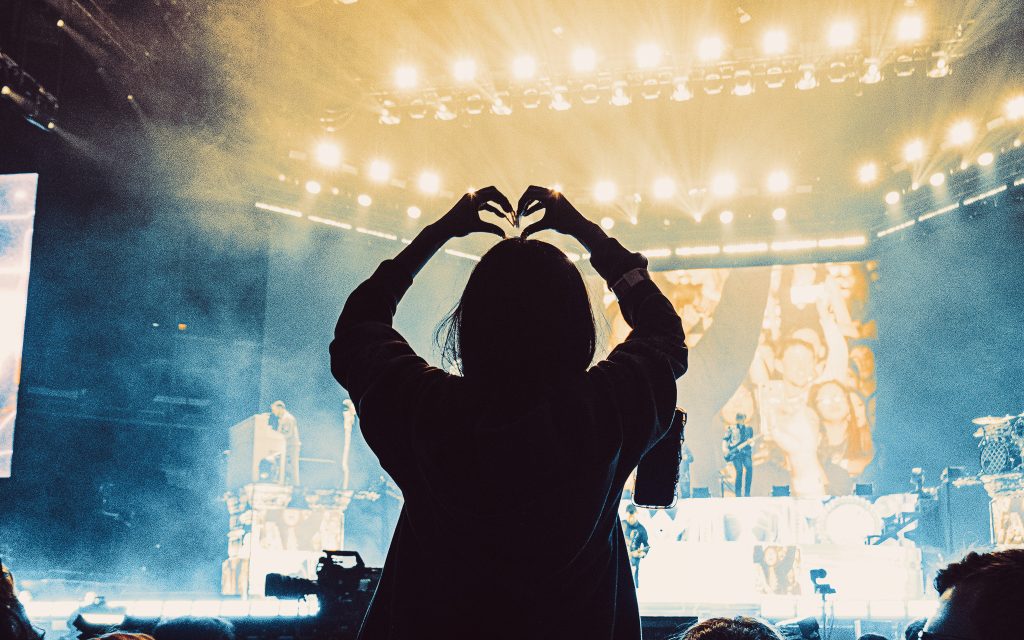
When “Can You Feel My Heart” finally hit, it felt like time collapsing inward. The years folded in on themselves, voices rising together in something almost therapeutic. Then the confetti — heart-shaped, drifting down in pink — filling the room, settling into my hands like something I’ve earned, something meant to be kept.
During “Drown,” Oli stepped into the crowd, breaking the barrier entirely. In a venue that large, it could’ve felt forced, but it didn’t. It felt like a reminder that this journey, this music, wasn’t just theirs. It was ours too.
When the night closed with “Throne,” it didn’t feel like an ending. It felt like a statement, something still unfolding. For everyone there, it wasn’t just a show; it was watching yourself grow alongside the music that carried you there.
all photos courtesy of Jessie Eshak
Leave a Reply