
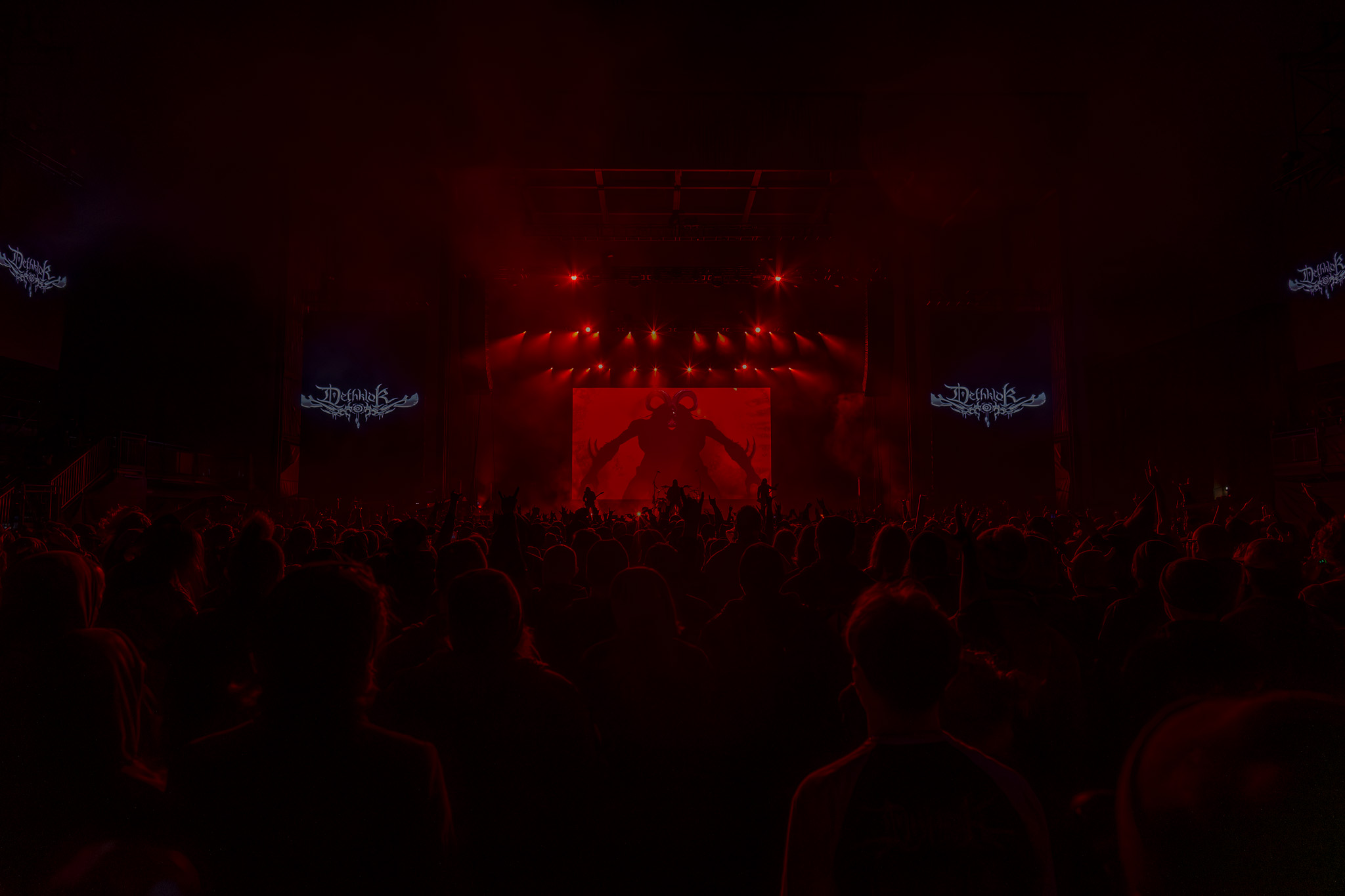
On Tuesday, May 19, “The Amonklok Conquest” brought Amon Amarth and Dethklok to The Junkyard in Denver, with Castle Rat also appearing on the bill. The rain came down throughout the night, but it did not slow the show, soften the crowd, or take anything away from the scale of the performance. If anything, the weather gave the night more teeth.
Outdoor shows can get strange when the weather turns. Sometimes the energy dips, people retreat, and the whole thing starts to feel like a scheduling mistake with speakers. This was not that. The crowd stayed locked in, the bands pushed harder, and the rain became part of the atmosphere instead of an obstacle. Denver fans stood through it, shouted through it, and treated the storm like one more thing to throw horns at.
Amon Amarth took the stage and made the rain feel like it had been ordered specifically for them.


Amon Amarth is one of those bands that seem almost impossible to catch on an off night. Their live show is built with the confidence of a band that knows exactly what it is, what its audience wants, and how to make a large-scale metal performance feel both ridiculous and completely sincere. Vikings, battle songs, massive riffs, synchronized crowd movement, and enough dramatic force to make subtlety file a formal complaint. It all works because Amon Amarth commits to it completely.
At The Junkyard, they were incredible in the way Amon Amarth always seems to be incredible. Their set carried the weight, precision, and spectacle that have made them one of melodic death metal’s most dependable live acts. The guitars hit with familiar warlike momentum, the drums pushed everything forward, and Johan Hegg commanded the stage with the kind of presence that makes a rainstorm feel less like bad weather and more like part of the lore.


There is a reason Amon Amarth has become one of the most reliable live bands in heavy music. Their shows are huge without feeling hollow, theatrical without feeling cheesy, and tight enough that even the most over-the-top moments still land with force. It is not just the Viking imagery or the stage presence; it is the fact that the band backs all of it up with songs that are built to move crowds.
The rain only made that connection stronger. Watching fans stay locked in through the weather, shouting along and refusing to give up their spot, made the set feel even more communal. Amon Amarth songs already carry that battle-chant quality, and in the middle of a storm at an outdoor venue, those moments hit differently. It felt less like a crowd watching a band and more like everyone had agreed to become part of the same absurd, soaked metal ritual.

The crowd gave everything back. Fans stayed loud, soaked, and fully committed, turning the rain into part of the shared experience instead of a reason to pull back. There is something uniquely fitting about watching Amon Amarth in a downpour while a crowd keeps shouting along like they have been personally summoned to some damp Scandinavian battlefield. Denver may not have fjords, but for a couple of hours, The Junkyard got close enough.
Amon Amarth’s strength live is not just the scale of the production. It is the clarity of the performance. The band knows how to make every song feel huge without letting the music get swallowed by the spectacle. The riffs remain sharp, the hooks land hard, and the crowd participation feels earned rather than forced. Even in the rain, or maybe especially because of it, the set felt larger than the venue around it.
After Amon Amarth turned The Junkyard into a rain-soaked battlefield, Dethklok stepped in and shifted the night into something stranger, darker, and gloriously absurd.
Dethklok’s return to the stage was surreal in the best way. What started as the fictional death metal band from Metalocalypse has always had a strange double life, existing somewhere between satire, real musicianship, and a genuinely beloved metal project. Seeing that world come alive again in front of a rain-soaked Denver crowd felt insane in exactly the right way. It was funny, heavy, theatrical, and somehow still completely serious once the music hit.


The set worked because Dethklok has never been a joke band pretending to be heavy. The absurdity is part of the world, but the songs land because the riffs are real, the playing is sharp, and the whole thing moves with ridiculous force. Live, the project becomes a full-sensory collision of animation, performance, and death-metal precision. It should not work this well. It does anyway, because apparently the universe occasionally rewards nonsense with excellent guitar tone.
The rain made the visuals and staging feel even more dramatic. Dethklok already lives in a world of cartoon violence, apocalyptic scale, and exaggerated metal mythology, so seeing that set unfold against an actual stormy outdoor backdrop gave the performance an extra layer of chaos. The weather did not compete with the show. It joined the production without asking for a crew pass.


The crowd was fully locked in from the start. Fans treated Dethklok’s set like both a long-awaited comeback and a shared cult ritual, shouting along, throwing horns, and reacting to the visuals with the kind of joy that only comes from watching something deeply ridiculous become genuinely powerful. The energy was not ironic. It was real. That is the weird magic of Dethklok. The concept invites you to laugh, then the music reminds you that the band can still crush a room.
Brendon Small’s creation has always understood metal’s scale and absurdity better than most supposedly serious projects. At The Junkyard, that balance came through clearly. The performance was massive without feeling empty, theatrical without losing its weight, and nostalgic without feeling like a simple victory lap. Dethklok’s comeback did not feel like a gimmick. It felt like a reminder that this strange animated monster still has real bite.


The pairing made the night feel like a collision of two very different forms of metal theater. Amon Amarth brought Viking-scale precision, physical power, and the kind of live show that turns weather into atmosphere. Dethklok brought animated chaos, absurdity, and a comeback that felt genuinely wild to witness. Together, they made “The Amonklok Conquest” feel less like a tour package and more like a full-scale event.
What stood out most was that the rain never became the story because it never stopped the show. It became part of the story because everyone pushed through it. The bands did not dial anything back. The crowd did not disappear. The night kept moving with the kind of stubborn, soaked determination that makes metal shows feel different from almost anything else. Sensible people may have looked for cover. Fortunately, sensible people were not in charge.
By the end of the night, Amon Amarth had once again proved why they remain one of the best live bands in heavy music, while Dethklok’s return was insane to see in person. Few bills could make a rain-soaked outdoor venue feel like part of the show instead of a problem to overcome. Denver stood through it, shouted through it, and for one night, The Junkyard felt less like a concert space and more like a battlefield with better lighting and animated death metal consequences.
“The Amonklok Conquest” did not just survive the storm. It used it. For a night built around Viking battle anthems and animated death metal madness, the rain was not a setback. It was the final piece of production design.
Leave a Reply