
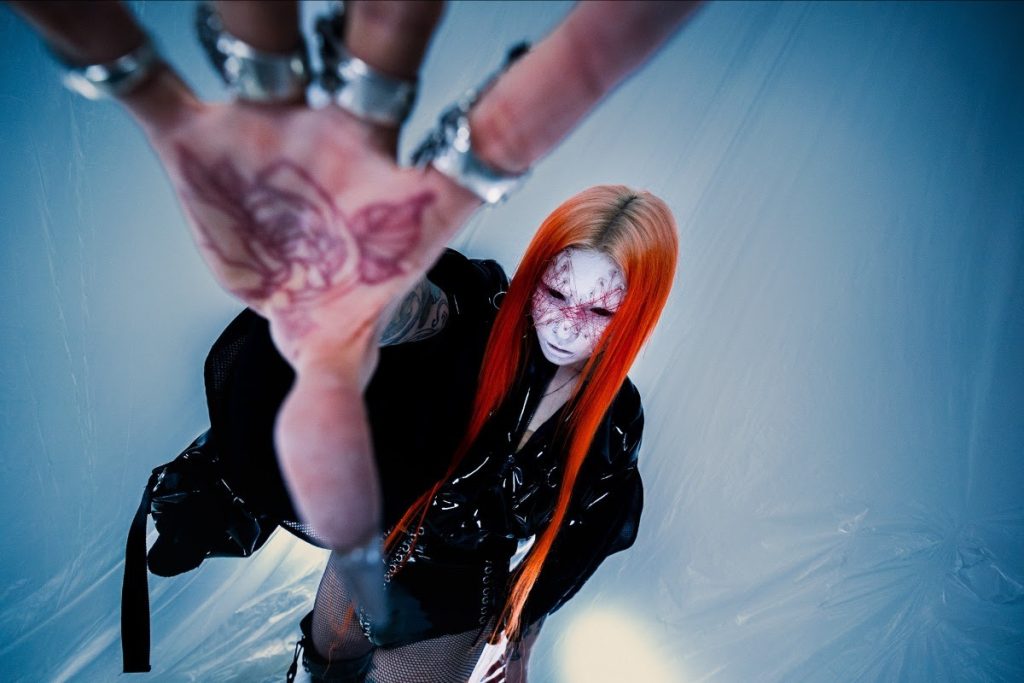
There are artists who spend entire careers searching for themselves, and then there are artists who willingly lose themselves over and over again. Mimi Barks belongs firmly to the latter. Every release, every city, every stage, every year feels less like another rung climbed on a ladder and more like another layer quietly peeled away, revealing someone entirely different underneath. Her music isn’t interested in standing still long enough to be defined. It mutates, corrodes, heals, and rebuilds itself in real time, just as she does.
That philosophy is impossible to separate from the world Barks has built around doom trap, the name she’s given to a sound that refuses to sit comfortably inside a single genre. Metal collides with trap. Industrial textures grind against electronic production. Punk urgency crashes into moments of startling vulnerability. It sounds chaotic on paper, but in practice, everything finds its place, existing less like a collision and more like tectonic plates constantly shifting beneath your feet.
The music follows the same path her life has. Berlin, London, and now Los Angeles don’t simply exist as cities scattered across a map. They feel like seasons, each one arriving exactly when another version of Barks had run its course. One taught her how to survive. Another demanded discipline. The latest seems to be asking her to dream bigger than she ever allowed herself to before. None of them represent a destination. They’re simply places she passed through on the way to whoever she’ll be next.
That constant movement pulses through “Dreamstate of Fear,” her latest EP, a record that never treats transformation as something graceful or comfortable. Instead, it embraces destruction as an unavoidable companion to growth. Fear gives way to awareness. Chaos gradually softens into acceptance. Heaven and hell stop feeling like places altogether and instead become states of mind we drift between every day. Listening to the record feels strangely cinematic, like wandering through a city after midnight where every abandoned warehouse and flickering streetlight somehow reflects something you’ve been trying not to confront within yourself.
Yet perhaps the most fascinating thing about Mimi Barks is that none of this was ever intended to become a character: “Creating Mimi Barks was never about creating a persona,” she explains. “It came naturally, and I evolved into this current version of myself. It was about giving a form to something that was constantly changing inside me.” Despite the origins being organic, Barks admits: “I still don’t know who or what I am, and I keep losing myself over and over again, destroying old versions of myself and evolving into something new. There is no final version, and there will never be one. I am the journey, and stagnation is death.”
It’s a striking statement, particularly in an era where artists are often encouraged to package themselves into something immediately distinct and recognizable. We like permanence. Labels. Clean narratives. Mimi seems almost allergic to all three. The person standing onstage today isn’t necessarily the one who wrote the previous record, and she has no desire to preserve older versions of herself simply because they’re familiar. If anything, familiarity feels like the one thing she’s trying to escape.
Oddly enough, that willingness to keep changing is what makes her feel so authentic. Nothing about Mimi Barks feels carefully manufactured. Even the darkness surrounding her work doesn’t come across as aesthetic for aesthetics ‘ sake. It feels lived in, earned, the natural result of someone willing to sit with uncomfortable emotions long enough to understand them instead of decorating them. Every song becomes less a performance and more of a snapshot, preserving whoever she happened to be before inevitably becoming someone else again.
Looking back, maybe that constant evolution was already there long before Berlin clubs, European festivals, or Los Angeles studios ever entered the picture: “My first introduction to music was a tiny drum kit in my grandma’s basement when I was around four or five years old,” she remembers. “I don’t remember it as a conscious decision to become a musician, but I do remember the empowerment and excitement I felt when playing the drums for the very first time.”
It’s a remarkably simple memory, almost ordinary. No grand revelation. No lightning bolt. Just a child sitting behind a tiny drum kit, discovering that sound could make her feel powerful before she was even old enough to understand why.
Looking back now, it’s difficult not to see the thread connecting that basement to everything that followed. Before the stages, before the festivals, before doom trap even had a name, there was simply a little girl discovering that music had the ability to become what she needed it to be. The genres would eventually evolve. The cities would change. Versions of herself would come and go. But that feeling, the empowerment she first found with a pair of drumsticks in her grandmother’s basement, never really left. It simply kept transforming alongside her.
Every artist has a moment where admiration quietly transforms into conviction. For Barks, it didn’t happen onstage or after hearing a perfect song through a pair of headphones. It happened inside a studio apartment in Berlin, where the walls were concrete, the afternoon sunlight spilled orange through the windows, and two musicians found themselves wondering if there was still room in the world for something genuinely different. Before that day, the music already existed. The vision, however, had fully arrived.
“It was 2018 in Berlin, and me and my drummer and producer, Koen, sat in our studio in Marzahn. It was a late afternoon, and the orange light of the sunset started to hit the window of our room in that concrete skyscraper block of a building.”
Traveling back, the setting almost feels symbolic. Berlin had already begun shaping her, teaching her to survive inside a city where underground culture never asks permission to exist. Yet survival wasn’t enough anymore. They had spent the day writing without really arriving anywhere, caught in that frustrating space every creative eventually encounters where the ideas refuse to become songs.
“I remember we weren’t really getting anywhere with writing that day, and we contemplated about the lack of vision and go-getter attitude in the German music industry. They never understood what we were trying to do, and I wasn’t trying to conform to what they wanted me to be either.”
That sentence quietly reveals something that’s remained true throughout every chapter of Mimi’s career. Long before doom trap had a name, she already knew what it wasn’t. It wasn’t going to be softened into something more commercially comfortable. It wasn’t going to fit neatly inside the boxes people wanted to place around it. The easiest road was never particularly interesting to her, especially if reaching the destination meant abandoning the very thing that made the music feel alive in the first place.
Then Koen opened YouTube: “Then Koen opened his laptop, went on YouTube, and started playing The Prodigy – Live at Phoenix Festival 1996.” And sometimes inspiration doesn’t arrive as a quiet whisper. Sometimes it detonates. “We watched the entire show, and I felt this sense of euphoria. It was a feeling of excitement I’ve only ever remembered having felt as a kid. That energy coming from the crowd and Maxim, Keith, and Liam on stage felt so intense as if the show was happening in real time right in front of my eyes.”
Listening to Barks describe that afternoon, it’s striking how little she actually talks about the songs themselves. Instead, she remembers the feeling. The voltage moving between stage and audience. The complete absence of hesitation. The overwhelming certainty that authenticity can be louder than perfection if you’re brave enough to trust it. It wasn’t simply admiration for The Prodigy. It became permission.
“It was a confirmation that I shouldn’t ever conform to anyone, trust the journey, and take the long and hard but authentic path. It was confirmation that authenticity isn’t debatable; it’s the essence.”
That philosophy quietly flickers beneath everything Barks creates today. Doom trap doesn’t sound like a calculated attempt to invent another subgenre. It emerges from someone refusing to choose between the music that shaped them. Metal never asks permission to exist beside trap. Industrial textures aren’t cleaned up to make room for pop. Punk urgency collides with electronic product because, to Barks, those worlds were never separate to begin with.
If Berlin became the city that taught her survival, London slowly transformed into the place where survival became discipline: “It was the labour phase. I spent a lot of time isolated, working on myself and my skills and learning what it means to commit fully to the process.” Then came Los Angeles. Not as an ending, but another beginning: “Los Angeles is teaching me expansion. It feels like the place where I am finally able to fully live my artistry, connecting with other creatives, collaborating, and allowing the vision to exist on a larger scale. I love the energy here: the belief that anything is possible and the drive to make things happen.” The three cities almost read like chapters inside the same novel. Berlin gave her the foundation. London quietly sharpened it. Los Angeles is simply handing that vision a larger canvas.
When asked where her music physically exists, she doesn’t hesitate: “It would be a scene out of Blade Runner. A post-apocalyptic scenery with abandoned warehouses and skyscrapers. A world that has already collapsed, but survived and emerged from the other side of it, in a transformed, indestructible form.”
It’s difficult to imagine a more fitting description, not only for her music, but for the artist herself. Everything Mimi Barks creates seems fascinated by what remains after collapse. Not the destruction itself, but the strange beauty that begins growing through the cracks afterward. In many ways, that’s exactly what authenticity has always looked like for her. Not conformity. Simply surviving long enough to become something entirely your own. It’s difficult to imagine a more fitting description, not only for her music, but for the artist herself. Everything Mimi Barks creates seems fascinated by what remains after collapse. Not the destruction itself, but the strange beauty that begins growing through the cracks afterward. In many ways, that’s exactly what authenticity has always looked like for her. Not conformity. Simply surviving long enough to become something entirely your own.
That indestructible world becomes the architecture holding “Dreamstate of Fear” together. The title was not the blueprint Barks wrote today; it surfaced only after the songs had already begun revealing what they were trying to say. “The music came first. The title ‘Dreamstate of Fear’ came later, as a way to describe the state of mind that the record explores.” In that sense, the name feels less like a label pressed into music and more like the moment she finally recognized the weather she had been walking through.
The EP does not move in a straight line, nor does it pretend healing ever does. “The EP is a journey through duality, from fear, anxiety, chaos, and destruction into acceptance, love, awareness, and spirituality.” Each track feels like another room in the same deteriorating structure, some flooded with panic, others briefly illuminated by clarity. Nothing disappears entirely; the emotions simply change shape as Barks travels through them.
For Barks, heaven and hell are not distant destinations waiting somewhere beyond this life. “It explores the constant choice between what I would describe as heaven and hell, not as physical places but as different states of consciousness.” She reduces those grand, ancient ideas into something much more intimate: the private decisions we make inside our own minds every day. “Everything is one, just expressed in different degrees.” The record refuses to draw a clean border between salvation and destruction because, in reality, we often carry both at once.
That coexistence is the heartbeat beneath every industrial scrape, trap rhythm, and crushing breakdown. “Darkness and light are not separate; they co-exist. One couldn’t be without the other.” In the universe Mimi Barks cultivates, softness doesn’t cancel out brutality, and brutality does not erase the possibility of tenderness. The music becomes powerful precisely because it allows both to stand beside one another without asking either side to shrink.
By the time “Dreamstate of Fear” reaches the other side of its own storm, the person who entered the record no longer exists in quite the same form. “The record starts in a place of inner conflict and madness but transforms into something more conscious, powerful, and liberated.” That shift is not immediate or particularly graceful; it feels like dragging yourself through wreckage, bloodied but newly awake. “It reflects the process of losing yourself, confronting your own darkness, and emerging on the other side transformed.” This is not a story about escaping fear as much as learning how to stare directly at it without surrendering.
The same refusal to separate creation from identity underpins DEATHKISS Records, the imprint Barks released the EP through. “DEATHKISS Records is simply another name for the same thing I have always been doing. It fascinates me how much weight people put on a title.” For Barks, founding a label was not a sudden promotion or an attempt to make the project appear larger than it was. The imprint simply gave language to the creative control she has been exercising all along.
That ownership stretches far beyond the songs enclosed on the record. “I have always made the creative decisions myself and been involved in every part of the process, from the music to the visuals, artwork, fashion and the entire world surrounding each release.” Every detail becomes another limb of the same body, from the clothing wrapped around her onstage to the shadows swallowing the artwork. DEATHKISS does not merely distribute Mimi Barks; it protects the full, uncompromised universe surrounding her.
The name itself carries the kind of contradiction her music has always thrived within. “The name DEATHKISS itself represents a paradox.” Something violent meets something tender, destruction pressed directly against affection until it becomes difficult to tell where one ends and the other begins. “It comes from the romanticisation of depression, the idea that creativity can only exist through suffering and pain.” The phrase preserves the version of Barks who once believed the wound had to remain open for the art to survive.
Yet, like everything else surrounding Mimi Barks, even the meaning of DEATHKISS was never meant to remain frozen. “But as I have evolved, I now see it differently. Creation doesn’t have to come from destruction only. It can also come through transformation, surrender and ego death.” Pain may have been the doorway, but she no longer believes she has to keep bleeding simply to prove the work is honest. “So in a way, DEATHKISS is both a reminder of where I came from and a reflection of where I am going.”
By the time a song fully reaches listeners, Barks has often already begun shedding the version of herself who created it. “Honestly, by the time a song is released I usually already feel detached from it. I spend so much time living inside a piece of music during the creation process that once it is finished and out in the world, I have already moved on.” It sounds almost cold at first, but it is really another form of survival. Releasing the work means loosening her grip, allowing the song to become evidence of a state she no longer needs to inhabit.
Even so, one track seems to hold the entire EP’s opposing forces in the same clenched fist. “However, ‘Dreamstate of Hell’ probably represents the duality of the EP the most. It’s got the contrast between melody, rap and heavy breakdowns, between beauty and decay, darkness and light.” The song does not ask listeners to choose which side of Barks is the most authentic because every fragment belongs to her. It stands as a miniature version of the world she has built, one where a delicate melody can be swallowed by a breakdown without either losing its power.
“When I initially wrote it, it was about capturing a specific inner state. Today, after everything that has happened, it feels less like a personal moment and more like the soundtrack of our time.” That shift reveals what happens once Barks releases control and allows the music to breathe beyond her original intention. A private collapse becomes communal, the inner nightmare widening until strangers can recognize their own fear flickering somewhere inside it. The record may begin as Barks’ dreamstate, but once it enters the world, it belongs to everyone still trying to wake up from their own.
“I don’t create with the intention of controlling what people take away from it. The moment I release something, it no longer belongs only to me. Everyone will experience it through their own lens. It’s all perception.” That surrender feels necessary for an artist whose entire body of work is built around refusing permanence; once the music is released, Barks loosens her grip and allows every listener to reshape it through whatever darkness, rebirth, or private wreckage they carried into the room.
That space feels especially important after years spent building the project through sheer motion, crossing from European underground rooms into major festival fields before completing her debut United States tour. “The biggest milestone for me during this cycle is to keep moving. I don’t deal well with stagnation. When things become too still, I find myself getting trapped in anxious cycles, and the thing that keeps me grounded is the feeling of progression.” For Barks, movement is not simply career strategy; it is a means of survival, a way to stop the mind from turning inward until the walls begin closing around it.
Progress can mean writing another song, stepping onto another stage, or waking up in a city she has never seen before. That’s creating, performing, travelling and experiencing life,” she says, reducing an entire philosophy into one restless sentence. Fresh from her first United States run and continuing through European dates alongside KING 810 and Wargasm, she appears most alive when the scenery refuses to remain familiar. Every show becomes another vein beneath the project’s skin, proof that doom trap was never meant to exist only behind headphones.
“I hope that this chapter is about playing more shows, being on the road, and feeling that energy from the crowds. I don’t necessarily measure success through specific achievements but through continuing to evolve and stay in motion. It’s the journey that matters, not the goal.” It is almost ironic to hear an artist with stages like Download Festival, Wacken Open Air, Bloodstock, Boomtown, and 2000 Trees already behind her speak so casually about milestones, but Barks has never seemed particularly interested in collecting trophies. The room matters, the people inside it matter, and the electricity exchanged between artist and audience matters; everything else is merely evidence that she kept moving.
There is, however, one field still circled in the distance. “But to perform at Hellfest in France is definitely on my bucket list for 2027.” The admission arrives almost playfully after insisting the destination does not matter, but Hellfest makes sense as a north star for someone who has spent years turning darkness into community. You can already imagine her DOOM TRAP universe opening beneath the festival lights – industrial percussion rattling the ground, screams splitting the night, beauty and decay standing beside one another without apology.
Yet when listeners eventually reflect on this era, Barks does not hope they remember a specific room, outfit, chart position, or festival poster. “I create primarily for myself, and Dreamstate of Fear represents a chapter of losing myself, rebuilding, and becoming something new. But if someone sees themselves in it, maybe they realize they are not trapped by who they were yesterday.” That is the invitation buried beneath the heaviness: not to admire her transformation from a distance, but to recognize your own capacity for it. The EP becomes less of a monument to who Barks is and more of a doorway out of whoever listeners thought they had to remain.
“I hope they understand that you can be broken and powerful at the same time. That vulnerability is strength, and that anger and aggression can be transformed into art and become salvation.” Heavy music has always understood that contradiction better than most genres, giving fear enough volume to become catharsis and rage somewhere safe to combust. Barks does not ask listeners to clean themselves up before entering her world; she asks them to bring every fractured piece and discover that brokenness does not disqualify anyone from power.
“We are more than the weight of the thoughts we have bled.” The line lands like the thesis of “Dreamstate of Fear,” but it also feels larger than one release. Barks has spent her career documenting collapse without allowing it to become the final scene, turning pain into percussion and anxiety into something audiences can scream back until it no longer belongs to them alone. Salvation, in her world, is not soft or spotless – it is loud, bruised, and still breathing.
Early in our conversation, Barks says, “I am the journey, and stagnation is death.” By the end, the words no longer feel like a dramatic declaration; they feel like the spine holding every city, record, and discarded identity together. Berlin, London, and Los Angeles were never separate lives, just different forms of the same restless evolution. “Dreamstate of Fear” will not be the final version of Mimi Barks because she has already begun moving beyond the person who made it.
Maybe that is what her legacy will become: not one fixed image, but the courage to keep destroying the frame. She is not asking to be remembered exactly as she stands today, because tomorrow demands another transformation. Her final words leave the door open for everyone willing to follow her through it: “Anyone has the power to choose to not be the same person twice.”
Leave a Reply